
The Future is Female: Systems Thinking in the Age of AI

Last week at the Digital Learning Annual Conference (DLAC) in Sacramento, I joined a panel titled: The Future is Female: How Women Are Shaping Digital Learning Innovation and Why DLAC is one of the premier national conferences on digital learning and online education. It gathers founders, district leaders, policymakers, virtual school innovators, and EdTech architects who are actively shaping the future of online learning in the United States.
This year, the dominant theme was artificial intelligence in education.
AI tools. AI tutoring. AI acceleration. AI-powered personalization.
But our panel moved the conversation in a different direction.
Women in EdTech Leadership: A Different Orientation Toward Innovation
I had the privilege of sharing the stage with:
Julie Young, Founder of Florida Virtual School
Mickey Revenaugh, Co-founder of Connections Academy
Isis Spann
Tillie Elvrum
These are women who have built some of the most influential digital learning systems in the country.
And yet the core of our conversation was not about scaling platforms.
It was about systems thinking in education.
In a room saturated with discussions about how fast we can scale AI, we asked:
Who are we scaling for?
What happens to the ecosystem when we scale?
What should artificial intelligence in education actually do?
This is a critical shift.
Because digital learning is not just a technology problem.
It is a systems problem.
Systems Thinking in Education: Moving Beyond
the Industrial Model
For decades, digital learning innovation has often been framed through an industrial lens:
Efficiency
Optimization
Automation
Disruption
Scale
But education is not a factory.
It is a living ecosystem.
Systems thinking in education requires us to look beyond isolated tools and examine relationships:
Student to teacher
Learner to community
School to family
Policy to practice
Technology to human development
When AI enters education, it does not simply add efficiency.
It shifts dynamics. It influences identity formation, teacher agency, belonging, equity, and access. Without systems awareness, AI can unintentionally optimize inequity at scale. With thoughtful design, however, AI in digital learning can become a tool that enhances personalization, increases accessibility, and expands opportunity. The difference lies in leadership philosophy.
Human-Centered AI in Digital Learning
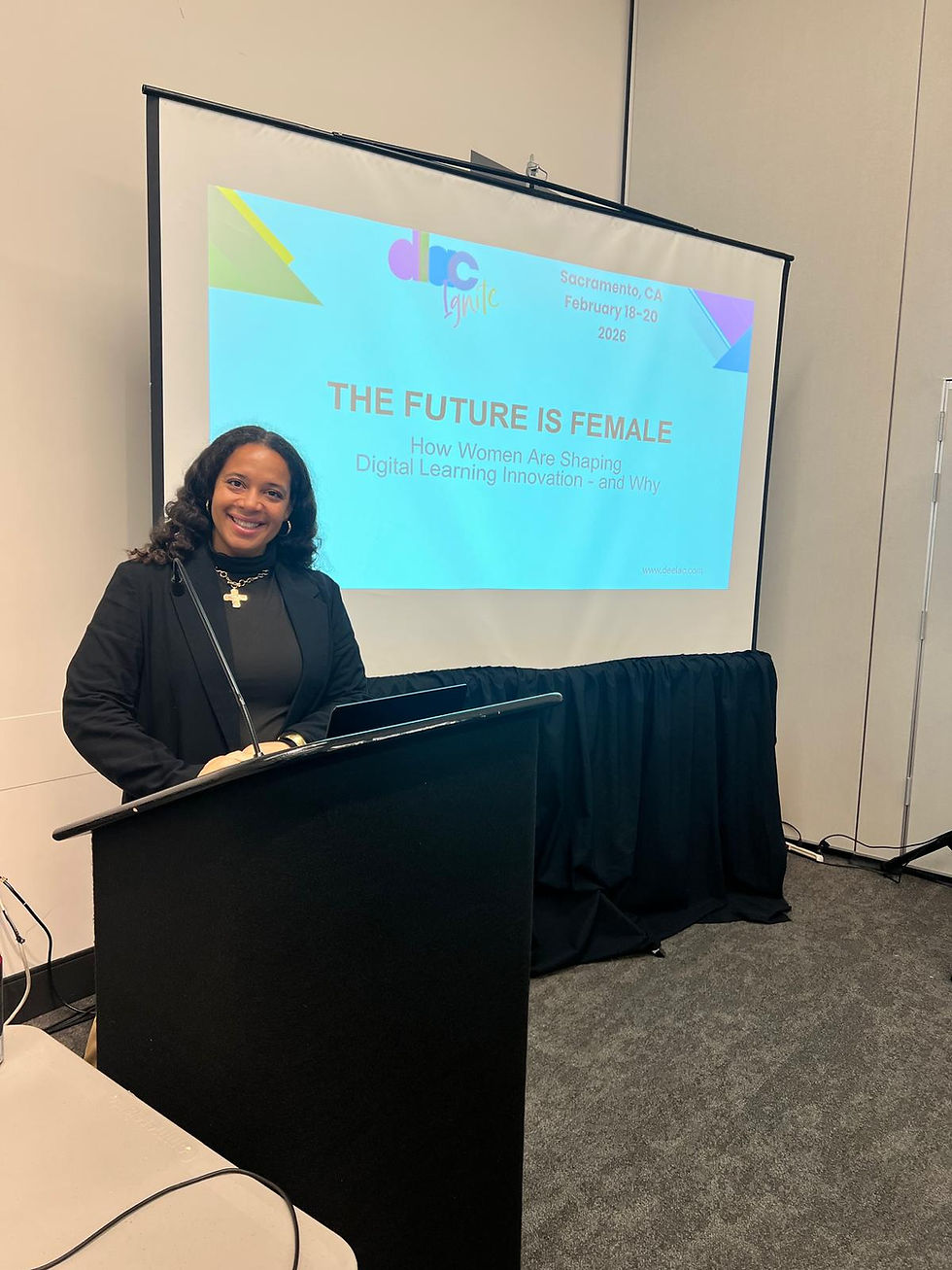
When we titled the panel “The Future is Female,” it was not about exclusion. It was about orientation.
Historically, women leaders in education have often built relationally and systemically. They tend to ask:
Who is unseen?
Who is underserved?
What are the long-term consequences?
How does this decision impact the margins?
In an AI-driven era, this orientation toward human-centered design is not soft. It is strategic.
The future of online learning will not be defined by algorithms alone.
It will be defined by the values embedded in those algorithms.
Human-centered AI in education requires:
Equity-aware system design
Attention to teacher experience
Safeguards for student belonging
Long-term sustainability beyond quarterly growth
This is systems thinking applied to digital learning innovation.
The Future of Education Leadership: Ecosystems, Not Empires
DLAC made one thing clear: We are at an inflection point in education.
The next chapter of digital learning innovation will not belong solely to technologists or platform builders. It will belong to ecosystem architects.
Leaders who can hold:
Innovation and care
Scale and sustainability
Acceleration and equity
AI capability and human dignity
Increasingly, women in EdTech are modeling this ecosystem-based leadership approach.
At Colossal Academy, this is the lens we operate through daily. AI is not the driver. It is one tool within a larger, relational, purpose-driven system designed to cultivate belonging, entrepreneurship, and agency.
Because the future of digital learning is not about replacing humans.
It is about designing systems where humans thrive.
Learning with purpose.Building the future.
— Shiren


This is such an inspiring topic! I've been working on some old conference videos and found an video upscaler really helpful for making them clearer without looking fake. Great read!