
Colossal Academy Featured in Reason: The Rise of Florida’s Microschools

We are excited to share that Colossal Academy was recently featured in Reason in a story exploring the rise of microschools in Florida and the growing movement of families and educators reimagining what school can look like.
The feature, “The Rise of Florida’s Microschools,” looks at what is happening as more Florida families gain access to education savings accounts and school choice programs and begin seeking educational models outside of traditional public and private schools. Colossal Academy is featured alongside WonderHere as an example of what this new generation of schools can look like.
For us, the coverage feels particularly meaningful because the story captures something we have believed since the very beginning: school does not have to look the way it has always looked.
From Four Students to a Different Way of Thinking About School
In the article, our founder, Shiren Rattigan, shares the unlikely beginning of Colossal Academy. In March 2020, what would eventually become Colossal started with just four students during the uncertainty of the pandemic.
At first, it was simply about creating a small learning environment that worked. Then the students began asking questions. Could they go to the beach? Could they garden? Could they learn outside? The answer was yes. Those early experiences opened our eyes to a much bigger possibility: everything in the world could become the classroom.
That idea continues to shape Colossal today.
When Reason visited our Fort Lauderdale campus, they saw students harvesting food from the garden and using it to cook stir fry. They saw a school where traditional academics exist alongside art, music, photography, drones and experiences in the real world.
This is not enrichment added around the edges of school. It is part of how we believe young people learn.

Why Microschools Matter
One of the most exciting parts of the Reason feature is that it places Colossal within a much larger shift happening in education.
Microschooling is growing across the country, alongside homeschooling, hybrid schools and other alternative learning communities. The article cites estimates that microschools now serve approximately 750,000 students nationwide and notes that these schools serve a disproportionate number of students with learning differences whose needs may not be met in traditional environments.
We see that need every day.
Some students need to move while they learn. Some need smaller groups. Some need more independence. Some need more support. Some need to spend part of their week outside. Some need an environment where an adult knows them well enough to recognize when something is not working and has the flexibility to change it.
Small schools allow us to respond differently.
One example shared in the article perfectly captures that. If our students tell us on Tuesday that they want to learn about drones, we can find the equipment, locate someone with expertise and begin creating that experience almost immediately. In a much larger system, introducing something new can require months or even years of approvals and planning. That ability to listen and respond is one of the things we value most about being small.
School Choice Is Making Different Models More Accessible
The Reason story also explores the role Florida's education scholarships have played in the growth of schools like Colossal.
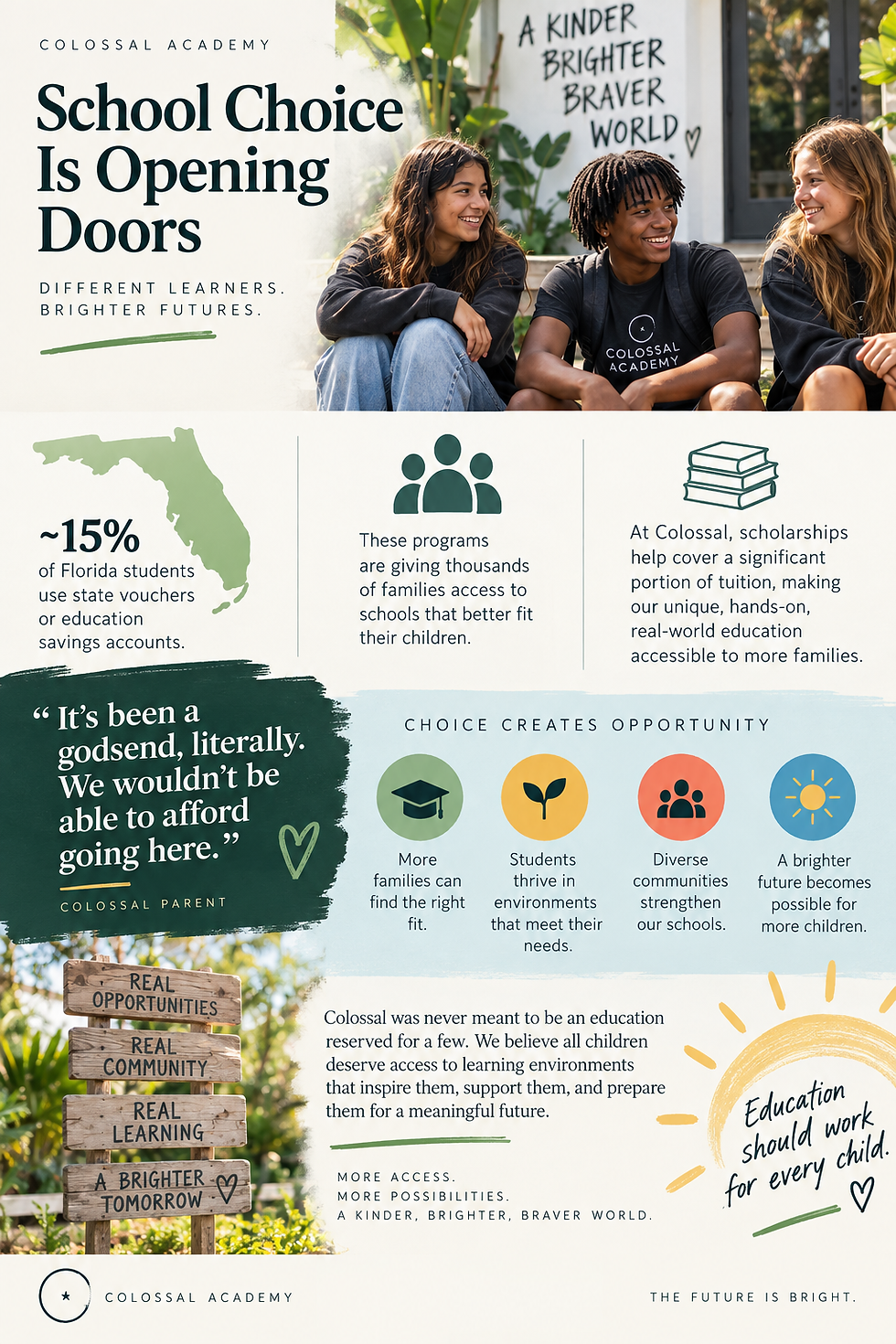
For many families, educational choice historically existed only if they could afford it. Florida's expansion of scholarships and education savings accounts has changed that equation for thousands of families. One Colossal parent interviewed for the story described the scholarship as a “godsend,” explaining that her family would otherwise not be able to afford the school. That matters enormously to us.
Colossal was never intended to be an educational experience reserved only for families with significant financial resources. If we believe children deserve learning environments that work for them, families from different economic backgrounds need meaningful access to those environments.
Rethinking Who Gets to Teach
The article also highlights another important part of the Colossal model: bringing people with real world expertise into the lives of young people.
Our communities are filled with artists, scientists, entrepreneurs, farmers, chefs, photographers, technologists, tradespeople and professionals who have spent years developing expertise. Traditional systems can make it difficult for those people to meaningfully participate in education.
We want to make that easier.
As Shiren explained in the article, subject matter experts may know their field deeply without necessarily knowing how to teach young people. Our job can be to help them learn how to teach while giving students access to adults whose knowledge and experience might completely change the way they see their future. That is part of what we believe the future of teaching can become.
Creating New Ways to Measure Success
The Reason feature does not shy away from the larger debate surrounding school choice. It explores questions about funding, regulation, accountability and what standards alternative schools should be expected to meet. Those are important conversations.
At Colossal, we believe deeply in academic rigor and measuring student growth. But we also believe that if education itself is changing, we should be willing to ask whether our definitions of success need to evolve with it.
As Shiren says in the article, “You can't use old standards to measure a new market.”
Test scores can tell us something about a student. They cannot tell us everything. We also care about whether students are curious, whether they can solve problems, whether they know how to advocate for themselves, whether they can work with other people, whether they have discovered things they genuinely care about and whether they feel that they belong in their learning community. Those things are harder to measure, but they matter.
Microschooling Is Here to Stay
Perhaps what we appreciate most about this coverage is that Colossal is being recognized as part of a larger national conversation about what comes next in education.
We started with four students and a willingness to say yes to doing school differently. Today, we are watching families, educators and school founders across the country ask many of the same questions we were asking in 2020.
What if school were smaller?
What if it were more personal?
What if students spent more time in the real world?
What if families had more choices?
What if educators had more freedom to innovate?
And what if we stopped asking children to fit into school and started building schools capable of fitting the children in front of us?
At the end of the Reason feature, Shiren says simply, “I think microschooling is here to stay.”
We believe that too.
We are incredibly grateful to Reason for spending time with our students, families and team and for including Colossal Academy in this important conversation about the future of education. Most of all, we are proud that the world is getting a chance to see what our students already know:
School can be different.
Join our community!


Comments